
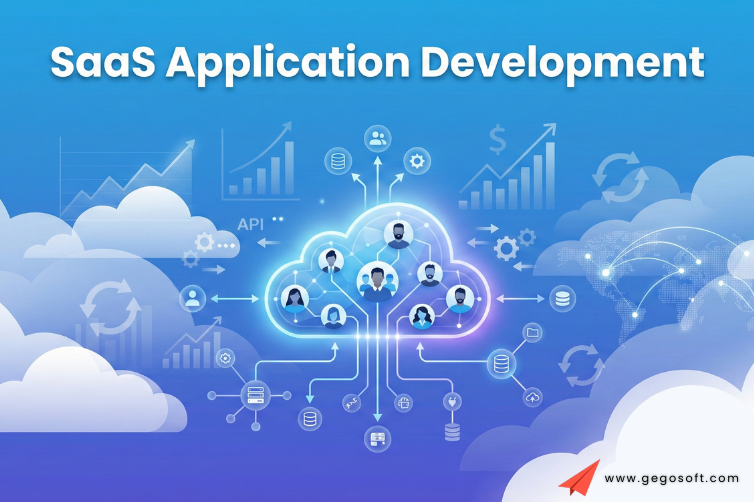
The Software-as-a-Service model has revolutionized how businesses deliver and consume software, with the global SaaS market projected to exceed $1 trillion by 2032. Whether you’re an entrepreneur with an innovative idea, an established company expanding into subscription services, or a startup disrupting traditional industries, SaaS application development offers unprecedented opportunities to build scalable businesses with predictable recurring revenue. Unlike traditional software requiring installation and maintenance on user devices, SaaS applications run in the cloud, accessible from anywhere through web browsers, continuously updated without user intervention, and monetized through subscription models that create sustainable business growth.
Successful SaaS application development requires strategic thinking beyond coding—understanding multi-tenant architecture, implementing subscription billing, ensuring enterprise-grade security, optimizing for performance at scale, and creating user experiences that drive retention and reduce churn. This comprehensive guide explores how professional SaaS application development transforms ideas into profitable cloud platforms that customers depend on daily.
Understanding SaaS Application Development in 2025
SaaS application development creates cloud-hosted software serving multiple customers (tenants) from shared infrastructure while maintaining data isolation and security. This architecture delivers significant advantages: automatic updates benefiting all customers simultaneously, predictable subscription revenue versus one-time licenses, lower customer acquisition costs through self-service trials, and scalability handling growth from startup to enterprise without architectural rewrites.
The SaaS application development landscape emphasizes developer velocity through microservices architectures, containerization enabling consistent deployment, API-first design facilitating integrations, and continuous deployment pipelines shipping features daily. Modern SaaS application development leverages cloud platforms like AWS, Azure, or Google Cloud providing scalable infrastructure, managed databases, global content delivery, and services enabling sophisticated features without building everything from scratch. When businesses partner with experienced application development companies, they gain expertise spanning cloud architecture, security implementation, subscription management, and growth optimization that distinguishes successful SaaS platforms from failed attempts.
Research indicates that SaaS companies with professionally developed applications achieve 65% lower customer churn rates and 40% faster time-to-market compared to those attempting DIY development, directly impacting revenue growth and competitive positioning in crowded markets.
Strategic Advantages of SaaS Application Development
Investing in SaaS application development delivers compelling business benefits that traditional software licensing models cannot match, fundamentally transforming how software businesses operate and scale.
Predictable Recurring Revenue Streams
SaaS application development enables subscription-based business models creating predictable, recurring revenue streams that investors value highly. Monthly or annual subscriptions generate consistent cash flow, improve financial forecasting, increase company valuations through higher revenue multiples, and reduce dependence on constantly acquiring new customers. This revenue predictability enables strategic planning, sustainable hiring, and long-term investment in product development impossible with one-time software sales.
Lower Customer Acquisition Costs
SaaS application development supports self-service models where prospects can trial software independently, significantly reducing sales costs. Free trials or freemium tiers let users experience value before committing, product-led growth converts users organically without expensive sales teams, automated onboarding reduces support requirements, and viral features drive organic customer acquisition. These dynamics enable SaaS businesses to scale efficiently without proportionally increasing marketing and sales expenses.
Continuous Improvement and Rapid Innovation
Unlike traditional software requiring lengthy update cycles, SaaS application development enables continuous deployment of improvements and new features. Developers ship updates multiple times daily, all customers automatically access the latest version, A/B testing optimizes features with real user data, and bugs get fixed immediately without waiting for update adoption. This agility enables rapid market response, competitive differentiation, and continuous value delivery that keeps customers engaged and subscribed.
Scalability Without Infrastructure Burden
Professional SaaS application development leverages cloud infrastructure that scales automatically with demand. Applications handle traffic spikes gracefully, infrastructure costs align with actual usage, global expansion happens through regional data centers, and teams focus on product development rather than server management. This scalability proves crucial as businesses grow—what serves ten customers scales to ten thousand without architectural rewrites or infrastructure crises.
Essential Components of Professional SaaS Application Development
Building successful SaaS platforms requires expertise across multiple technical domains that work together creating reliable, secure, and performant applications customers trust with their business operations.
Multi-Tenant Architecture and Data Isolation
SaaS application development implements multi-tenancy where single application instances serve multiple customers while maintaining strict data isolation. Tenant data never mixes or leaks, performance remains consistent regardless of other tenant activity, customization options accommodate diverse customer needs, and infrastructure efficiency keeps costs manageable. Architectural decisions around single vs. multi-database tenancy, resource allocation, and isolation mechanisms significantly impact scalability, performance, and operational costs.
Subscription Management and Billing Systems
Successful SaaS application development includes comprehensive subscription management handling plan selection, payment processing, upgrade/downgrade workflows, usage metering and billing, trial management and conversion tracking, and automated renewal and dunning processes. These systems typically integrate with specialized billing platforms like Stripe, Chargebee, or Recurly rather than building payment processing from scratch. When working with professional technology partners, subscription complexity receives appropriate attention rather than becoming an afterthought causing revenue leakage.
Enterprise-Grade Security and Compliance
SaaS application development prioritizes security because customers trust applications with sensitive business data. Security implementations include data encryption at rest and in transit, role-based access control and permissions, audit logging for compliance requirements, regular security assessments and penetration testing, SOC 2, ISO 27001, or industry-specific compliance, and disaster recovery and business continuity planning. Security isn’t optional—it’s foundational to building trust and qualifying for enterprise sales.
Performance Optimization and Monitoring
Users expect fast, responsive experiences regardless of load. SaaS application development implements comprehensive performance optimization through efficient database queries and indexing, caching strategies at multiple layers, content delivery networks for global performance, background job processing for heavy operations, and real-time monitoring identifying performance degradation. Proactive monitoring catches issues before customers notice, while performance analytics identify optimization opportunities improving user satisfaction and reducing infrastructure costs.
The SaaS Application Development Technology Stack
Modern SaaS application development leverages proven technology stacks balancing rapid development, scalability, maintainability, and developer availability.
Frontend Frameworks for Rich User Interfaces
SaaS applications require sophisticated, responsive user interfaces delivered through JavaScript frameworks. React dominates with its component-based architecture and massive ecosystem, Vue.js offers approachability with powerful capabilities, and Angular provides comprehensive framework for large applications. Server-side rendering with Next.js or Nuxt.js improves initial load performance and SEO while maintaining rich interactivity. Professional SaaS application development chooses frameworks based on team expertise, performance requirements, and long-term maintainability rather than chasing trends.
Backend Technologies and APIs
Backend SaaS application development handles business logic, data management, authentication, and API creation. Node.js enables JavaScript across the stack with excellent performance for I/O-intensive operations, Python with Django or Flask provides rapid development and readability, and Ruby on Rails offers convention-driven productivity for web applications. API-first architectures separate frontend and backend concerns, enabling mobile apps, third-party integrations, and headless implementations. Microservices decompose applications into independently deployable services, improving scalability and team autonomy as organizations grow. Partnering with experienced backend developers ensures architectural decisions support current needs and future growth.
Database Selection and Management
SaaS application development requires careful database selection balancing consistency, scalability, and query flexibility. PostgreSQL provides robust relational capabilities with excellent performance, MongoDB offers flexible schema for rapidly evolving data models, and Redis delivers blazing-fast caching and session management. Many SaaS platforms use polyglot persistence—different databases optimized for different data types and access patterns—maximizing performance while managing complexity appropriately.
Cloud Infrastructure and DevOps
Modern SaaS application development targets cloud platforms providing managed services, global infrastructure, and automatic scaling. AWS leads in market share and service breadth, Google Cloud excels in data analytics and machine learning, and Azure integrates seamlessly with Microsoft ecosystems. Container orchestration with Kubernetes enables consistent deployment and scaling, infrastructure-as-code automates environment provisioning, and CI/CD pipelines automate testing and deployment. These practices enable reliable, frequent releases while maintaining system stability.
Industry data reveals that 70% of new SaaS applications in 2025 incorporate AI-powered features, from intelligent search and recommendations to automated workflows and predictive analytics, making AI integration increasingly essential for competitive SaaS application development.
SaaS Application Development Best Practices
Following proven best practices distinguishes successful SaaS platforms from those that struggle with technical debt, security issues, or scaling challenges.
Start with MVP and Iterate Based on Data
Rather than building comprehensive feature sets before launch, effective SaaS application development emphasizes minimum viable products validating core assumptions quickly. Build core functionality solving the primary problem, launch to early adopters gathering feedback, analyze usage data identifying what resonates, and iterate based on real customer behavior rather than assumptions. This lean approach reduces risk, accelerates learning, and prevents building features nobody uses.
Implement Comprehensive Analytics and Metrics
Data-driven SaaS application development tracks key metrics guiding product decisions. Monitor active users and engagement patterns, measure feature adoption and usage frequency, track conversion funnels identifying drop-off points, calculate customer lifetime value and churn rates, and analyze performance metrics ensuring reliability. Analytics platforms like Mixpanel, Amplitude, or Heap provide behavioral insights impossible to gain through direct observation, enabling optimization based on evidence rather than intuition.
Prioritize User Onboarding and Activation
First impressions determine whether trial users convert to paying customers. Professional SaaS application development emphasizes onboarding optimization through progressive disclosure avoiding overwhelming new users, interactive tutorials demonstrating value quickly, contextual help and tooltips guiding discovery, and personalized experiences based on user roles or industries. Successful activation—users experiencing core value quickly—dramatically improves conversion rates and reduces early churn.
Build for Security from Day One
Security cannot be bolted on later. SaaS application development must implement security throughout development through threat modeling during design, secure coding practices and code reviews, dependency scanning for vulnerable libraries, regular security testing and penetration testing, and incident response plans for security events. Security investments pay dividends in customer trust, reduced breach risks, and qualification for enterprise deals requiring security certifications. When businesses engage security-conscious development teams, protection becomes foundational rather than aspirational.
Monetization Strategies for SaaS Applications
SaaS application development must align with viable monetization models ensuring sustainable business growth and profitability.
Subscription Tiers and Feature Gating
Most SaaS platforms offer multiple subscription tiers with increasing features and capabilities. Basic tiers attract price-sensitive customers, professional tiers serve growing businesses, and enterprise tiers deliver advanced features, support, and SLAs. Effective tiering balances value delivery with revenue optimization, ensuring each tier feels complete while creating clear upgrade incentives.
Usage-Based Pricing Models
Some SaaS applications charge based on actual usage—API calls, storage consumed, transactions processed, or active users. Usage-based pricing aligns costs with value received, lowers barriers for small customers starting affordably, and scales revenue automatically with customer growth. However, unpredictable costs may concern some customers, requiring clear usage monitoring and billing transparency.
Freemium and Free Trial Strategies
Freemium models offer limited functionality free indefinitely, monetizing premium features, while free trials provide full access for limited periods. Both strategies reduce friction enabling users to experience value before committing. Successful freemium requires clear upgrade paths where free users hit meaningful limitations driving conversion, while effective trials ensure users reach activation milestones experiencing core value during trial periods.
Frequently Asked Questions About SaaS Application Development
How long does SaaS application development typically take from concept to launch?
Development timelines vary based on complexity and scope. Simple SaaS MVPs might launch in 8-12 weeks, mid-complexity platforms typically require 4-6 months, and comprehensive enterprise SaaS often needs 9-18 months or longer. Professional SaaS application development emphasizes iterative releases delivering core functionality quickly while continuously adding features based on user feedback rather than waiting for complete feature sets before launching.
What does professional SaaS application development cost?
Costs depend significantly on scope, team location, and complexity. MVP development might range from $50,000-$100,000, full-featured platforms typically cost $150,000-$400,000, and enterprise solutions can exceed $500,000. While substantial, professional development delivers architecture supporting scale, security meeting enterprise requirements, and subscription management enabling business growth—fundamentals that expensive rewrites later cannot easily retrofit into poorly architected systems.
How do you handle data security and privacy in SaaS application development?
Security-conscious SaaS application development implements multiple protective layers including encryption for data at rest and in transit, strong authentication with multi-factor options, role-based access controls limiting data exposure, regular security audits and penetration testing, compliance with relevant regulations (GDPR, HIPAA, SOC 2), and comprehensive logging for security monitoring. Security requires ongoing vigilance rather than one-time implementation, with continuous monitoring, prompt patching, and regular security assessments ensuring protection evolves with emerging threats.
Can SaaS applications integrate with other software and services?
Yes, integration capability distinguishes competitive SaaS platforms. Professional SaaS application development includes robust API design enabling integrations, webhooks notifying external systems of events, pre-built integrations with popular platforms, authentication supporting various protocols (OAuth, SAML, SSO), and marketplace ecosystems where partners build additional integrations. Integration capabilities directly impact enterprise adoption where SaaS platforms must work within existing technology ecosystems rather than requiring replacement of established tools.
How do you scale SaaS applications as customer base grows?
Scalable SaaS application development implements cloud-native architectures leveraging automatic scaling, uses caching extensively reducing database load, implements queue systems for asynchronous processing, monitors performance proactively identifying bottlenecks, optimizes database queries and indexing continuously, and architectures using microservices enabling independent scaling of components. Professional development considers scalability from inception rather than attempting to retrofit scaling capabilities into applications experiencing growth-driven performance crises.
Launch Your Successful SaaS Platform with Expert Development
SaaS application development represents one of the most attractive business models in modern software, combining recurring revenue, scalability, and continuous customer relationships that create sustainable competitive advantages. However, success requires more than building features—it demands architectural excellence, security rigor, subscription management sophistication, and growth optimization that distinguish thriving SaaS businesses from struggling platforms.
At GegoSoft Technologies, our SaaS application development services combine cloud architecture expertise with subscription business understanding and security implementation rigor. We’ve launched successful SaaS platforms across industries, consistently delivering applications that scale reliably, protect customer data, convert trials into subscriptions, and support sustainable business growth. From initial strategy through MVP launch, feature expansion, and ongoing optimization, we ensure your SaaS platform achieves technical excellence while driving business results.
Ready to transform your software idea into a thriving SaaS business with recurring revenue and scalable architecture? Contact our SaaS development team today to discuss your vision, target market, and growth objectives. Let’s build a cloud platform that customers depend on daily while creating the predictable, recurring revenue that drives sustainable business success.